CAMP GLOW (KASAMA)
Summary from ‘News from Zambia’, a compilation of press coverage. Original Article ran in ‘The Post.’
Official urges more ties in life skills empowerment
- Senior Education Standard Officer Dennis Chisulo said there is need for collaboration to empower youths in the country with life skills.
- During the graduation of 21 youths who participated in the ‘Girls Leading Our World’ sleep-over-camp at Kasama Girls High School organized by Peace Corps volunteers in collaboration with Planned Parenthood Association of Zambia, Chisulo said government appreciated the support of stakeholders in gender youth development.
- Peace Corps Project Coordinator Sally-Rose Mwachilenga said this was the fourth camp, others having been held in Chipata, Chongwe and Serenje. Mwachilenga said the other camp was expected to be held in Mpika. Camp Glow is an initiative of Peace Corps volunteers aimed at encouraging girls to become active citizens of society. (The Post)
Camp Girls Leading Our World (GLOW) was created by Peace Corps volunteers in Poland but has since moved all over the world. Camp GLOW Kasama was held from 6 – 10 December and organized by 10 Peace Corps volunteers, each of whom brought two female grade 7 or 8 pupils and one teacher or community leader from their respective villages. Activities included sessions on HIV/AIDS, rape and sexual assault, sugar daddies, confidence and self-esteem, journaling, sewing menstrual pads, and games. The girls were groomed to be peer educators and expected to create GLOW clubs at their schools. In Zambia, girls are less likely to be educated in higher grades than boys owing to familial pressures for the girls to get married, teenage pregnancy, and cultural expectations about the role of women. In poor, rural villages, especially in ours since the Sable road workers have moved in, sex is about economics. Girls expect to be given gifts or money if they hook up with older (often married) men with stable incomes, so this compromises their ability to negotiate condom use or refuse sex. A very high number of girls are sexually assaulted, with the guilty very rarely prosecuted. Girls are very vulnerable, and the purpose of GLOW was to empower them to practice abstinence, stay away from sugar daddies, respect themselves and their bodies, and plan for their futures rather than short-term goals.
SOUTH LUANGWA NATIONAL PARK
MFUWE, EASTERN PROVINCE OF ZAMBIA
South Luangwa is one of the premier national parks in the region. We stayed at Flatdogs lodge for three nights, camping on a treetop platform amid curious vervet monkeys. Hippos came to graze on the field at night from the nearby river and elephants also wandered through, so we were relieved that our tent was several metres of the ground. We went on a day drive and a night drive, so we saw many different animals. The best sight came when our guide heard a group of baboons making an alarm call. He sped the land cruiser off in their direction, and we found around fifty baboons hovering under a large canopied tree and screaming up at the branches. After a few moments, a leopard leapt to the ground, skulking away. The largest baboons trailed him, chasing him away with their persistent vocalizations and sheer number. The leopard hadn’t made a kill, and was probably only dozing in the tree, but the baboons showed him there is strength in numbers.
We also saw four lionesses sleeping in the shade. That’s the first time we’ve seen more than one solitary lion.
NKHATA BAY
MALAWI
From Eastern Province, we crossed the border into Malawi. Our destination was the northern part of Lake Malawi, around 700 kilometres from the capital city of Lilongwe. We stayed in a bamboo hut right on the beach at Njaya Lodge. The people in Nkhata Bay were very friendly, and there were even three kids that came right up to me and attached themselves around my legs in a hug, and a group of young girls that were swimming and wanted to play, using the few English words they knew. Kids in our village that know me well will crawl all over me, but the ones who I don’t see often are terrified of me and the younger ones will burst into tears at the sight of me. So I was surprised how fearless the Nkhata Bay kids were around white people.
We took a boat trip to the cliff where the fish eagles live. The fish eagle, which closely resembles the majestic American bald eagle, is the national bird of both Malawi and Zambia. These wild eagles have been trained so that when they hear a whistle and see a fish being thrown into the water, they’ll fly down by the boat to retrieve the fish, presenting tourists with a unique photo opportunity. Chris, of course, took full advantage.
We also got to snorkel off the shore around schools of bright, tropical fish. Then we tried paddling the local canoes, made from dugout logs, and jumped off a cliff into the clear water. There was a village nearby, so there was a bunch of young boys also jumping from as high as 5 metres. They were fearless, even scrambling into a nearby mango tree to get even higher from the water, and screaming as they plunged down. I jumped from 3 metres up, but got really nervous jumping from higher because I was blind without my glasses.
The official language is iciChewa, which is closely related to iciNyanja, which we can understand a bit because it’s close to iciBemba. So it probably would have been easy to pick it up if we stayed for a longer period of time, but we mostly stuck to the words we knew because they were the same in iciBemba.
From Nkhata Bay, we took an excursion to Nyika National Park, possibly one of the most beautiful places in Africa. It’s called the Scotland of Africa for its rolling green hills and incredible views to as far away as Zambia. It was even more dramatic with dark blue storm clouds hovering above. We camped there for two nights, and had to pay a significant sum to hire a vehicle as the park is so remote it’s impossible to get there by hitch hiking, but it was well worth it. There are no dangerous animals in the park, so it’s safe to walk, and by walking you can get very close to zebra and roan antelope. Nyika is one of the few places where you can see roan antelope, which have a clumsy almost moose-like brown body and a white mask. Chris got some awesome pictures of the zebra because we were able to get so close to them.
After a wonderful Christmas in Malawi, we crossed back over to spend the New Year in Zambia. Unfortunately, we had a hang up at the border. We had crossed from Zambia on 17 December and were granted a no-fee visa for ten days. We returned to the Mchinji border post on 27 December. The 17th to 27th December is actually eleven days, according to immigration officers. So, we were asked into the office to speak with the in-charge, who turned out to be a corrupt, misogynist. After being in Africa for two years, you know when something is a big deal and when something is insignificant, but played up by officials so they can get a bribe. This guy, who refused to give us his name, said we had to either return to Lilongwe to request an extension (half a day’s journey away and we had very little money) or pay him 5,000 Malawian kwacha each (around USD $66). He had our passports and refused to let us leave the office. Then he said if we refused to pay, he’d cancel our passports so that we’d never be allowed back to Malawi, and hinted that this would effect us at immigration at the entry point in Zambia. I flipped out, which I think was justified and raised my voice. I can’t remember exactly what I said (it was mainly the mefloquine talking, my malaria prophylaxis which makes me somewhat bipolar and anxious), but it was enough so that the guy refused to address me from that point on. He even told Chris that I was acting like an animal and that he would throw me in the cells if I didn’t calm down. Chris took on the good cop role and tried to be respectful, which I couldn’t stomach because he was trying to show us that we were white, and therefore inferior in his office. I left the room in a huff before I said something I’d regret too much, then I marched back in and proclaimed that we were calling the US Embassy and our “boss.” Only Chris’ phone had a Malawian sim card to make outgoing calls, so he phoned Peace Corps’ Safety and Security officer, Allan. I muttered about how our “boss” would solve everything. The guy quietly stamped our entry on our passports and slid them across the desk at us as Chris was on the phone. When he hung up, the guy said we could leave. Then he launched into another obloquy about how Chris had to control me because I was an animal, so I ran out with my passport. Chris relayed what Allan had told him on the phone: The most the immigration officials could do was give us a warning, so the guy was only blowing hot air. He could have canceled our passports from entering Malawi, but it couldn’t be enforced, as we were using temporary no-fee government passports, not our civilian ones, and record-keeping isn’t that great.
Outside immigration, I cried to the sympathetic money-changers, then Chris and I discussed rates with them and quickly changed the small amount of money we had left to Zambian kwacha. Their rates are only slightly higher than a bank’s, but they’re more convenient, especially for small sums. We walked across to the Zambian entry point, and a white woman stopped us in the parking lot. “Did you just exchange money over there?” She asked. We said yes. “Isn’t that illegal?” She wanted to know. I studied the gravel parking lot intently. Chris shifted uneasily. We were both silent for a long time, thinking she was a plainclothes border post cop, then Chris mumbled “I don’t know.” The truth is we hadn’t really thought about it. They’re a conspicuous sight at African border crossings, and they often change currencies just out of view of the police. “I think they are,” the woman finally responded. “Did they give you a good rate? I was also thinking about exchanging some money.”
LAKE KARIBA
SOUTHERN PROVINCE, ZAMBIA
Lake Kariba is the favorite vacation spot for expatriates. It makes up part of Zambia’s border with Zimbabwe, and was created in the 60s after Kariba dam was created for hydroelectric power. Bradt’s guide book warns not to walk in the bush at Lake Kariba, because there are still unexploded land mines from Zim’s independence struggle.
We stayed at the Bush Club. Luckily, there wasn’t much bush. The owners had a herd of zebra, some cows, and a pet goat that roamed the facilities, but they’d also stocked the nearby islands with game and owned a crocodile farm. We wanted to go on a game walk on the island with a guide, but the owner said the scouts had reported that the elephants had swum over that day and the island wasn’t safe to walk on. The scouts had been charged that day. The elephants had emigrated from Zimbabwe, and were quite ferocious around people because Zim’s political problems meant animals weren’t well protected from poachers.
The owner felt bad so he took us on a tour of the crocodile farm for free. We wouldn’t have paid because we’d already been to a croc farm in Livingstone, but this turned out to be much better. They had many more crocs, and were the second largest crocodile farm in the world. Each year, they hatched around 16,000 crocodiles. They also captured and used “problem crocs” from around Lake Kariba; the ones that had killed people. They harvested the crocs at three years of age. Their skin was exported, and 2% of the meat was exported to Holland. The other 98% was fed back to the crocs, as they do practice cannibalism in the wild. Others were kept for breeding. We drove a land cruiser into the breeding area, which was several acres of a scenic pond fenced off with electrical wire, rather than an artificial cement pool that I’ve seen at other places. The crocodiles were so thick that the driver was beating a stick on the road to get the crocs to slide out of the land cruiser’s path. It’s the closest I’ve ever been to crocodiles, being literally just a bit above them sitting in a land cruiser. They threw out chicken innards to the crocs and we saw them feast.
We also ate crocodile curry at the Bush Club. We both love crocodile meat. I don’t know why it’s not more popular in Zambia or even the US. It’s delicious. In Zambia, you can usually only find it at game park lodges or at croc farms.
On New Year’s Eve, we took a sunset boat cruise on Lake Kariba around the islands that were stocked with game. It was the first time Chris had seen wildebeest. Back at the Bush Club, the other guests were mostly families with kids or older people, so most people were in bed by 21 hours. Chris and I sat at the bar drinking overpriced Mosi’s and watching music videos on VH1. Then another couple joined us; Vic and Helen from Lusaka, who’d put their 6-year old to bed. I think all of us were glad there was some companionship. Vic was born in Kasama, then moved to Ireland at age 12 with his
Irish mother when his parents split up. He was educated in Ireland and met his wife there, but they’d decided to move to Zambia ten years prior. At quarter of midnight, the winds began getting strong, and Vic ran back to the chalet to get some champagne. Electricity and thus the music videos went out, and the storm descended with a vengeance. At one point, Helen said “My watch says it’s midnight.” “I have 23:57” Chris responded. Mine and the bartender’s also displayed different times. We drank more Mosi’s and gazed at the storm ushering in 2011. Vic didn’t return. Fifteen minutes later the rain let up a bit so we went to their chalet to drink champagne. Their chalet was absolutely flooded as the windows had only screens. Our tent had a sizeable puddle at the foot. Still, it was 2011 at a lakeside bar in Africa.
Vic and Helen ended up adopting us and not only gave us a ride back to Lusaka (it took 6 hours returning; we spent almost 11 hours getting there on buses and hitch hiking on canter trucks) but let us stay at their house for two nights. We only had to put up with endless replayings of Toy Story 3 (surprisingly not horrible) and their son Aaron, an only child that would talk your ear off. Chris bonded with him, because he said he was the same way growing up as an only kid.
We then traveled to the Peace Corps office on the other side of town for our Close of Service conference. We were rewarded for our two years of service by lodging at the Taj Pamodzi, one of Lusaka’s fanciest hotels, on the US taxpayer’s dime. It was probably a bad idea putting twenty young PCVs accustomed to the bush and harsh conditions in a five star hotel. Or at least a hilarious one, as each of us had five plates a piece at the buffet every meal. They served three kinds of meat at every meal! We eat meat once a month, and that’s because we can buy it at the ShopRite in Kasama when we come in monthly. The Taj also restocked bottles of water and pens at the conference room after every break we had, so we stockpiled everything. I don’t even drink bottled water in Lusaka; I drink tap water.
PCVs usually stay at Chaminuka, a fancy safari lodge 50 km out of Lusaka for COS conference, but we got bumped out because the Vice President of Zambia wanted to hold an emergency meeting there. We ended up getting a free day there on Sunday because Chaminuka felt bad they couldn’t accommodate us. We went on a game drive (they also have stocked game on their property), but got rained out. We did see a giraffe right by the side of the road on the way out though. They had an amazing lunch buffet though and a jacuzzi.
PRE-SCHOOL CONSTRUCTION
We travel back to Kasama tomorrow (13 January) and I’m meeting Ba Allan and Ba Catherine there to buy building materials for the pre-school. I’ve been out of the village on our mega vacation for a month and a half, but I spoke with Ba Allan tonight and the community has been mobilized and is ready to start construction. Hassim, the owner of Sable construction, has agreed to donate and transport the tons of crushed stone we need. The Mumana Youth Care and Supporting Group molded and burned the necessary 12,000 bricks months ago. The parents are very supportive. Stay tuned...
THANKS AGAIN TO EVERYONE WHO HAS HELPED TO MAKE THE PRE-SCHOOL CLASSROOM A REALITY.
Wednesday, January 12, 2011


Tuesday, January 4, 2011
I promise I'll post about our mega vacation and our adventures in South Luangwa National Park, Lake Malawi, Nyika Plateau, and Lake Kariba when I get a chance.
In the meantime, thanks again to Appropriate Projects for making the protected spring box a reality. It's of course hard to measure, but I think safe drinking water can prevent some of the needless deaths of children in our village, and also improve the health of people with HIV or other chronic illnesses.
Here's the completion page:
http://appropriateprojects.com/node/474
In the meantime, thanks again to Appropriate Projects for making the protected spring box a reality. It's of course hard to measure, but I think safe drinking water can prevent some of the needless deaths of children in our village, and also improve the health of people with HIV or other chronic illnesses.
Here's the completion page:
http://appropriateprojects.com/node/474
Tuesday, November 16, 2010
Pictures Depicting Everything Mentioned Below (plus village moonshine)
http://www.flickr.com/photos/nswaswa/
Caterpillars
Right after the first rains begin, women trek into the bush to collect caterpillars. Armed with a pail and often a child to climb the trees, they collect many different varieties: fat neon green ones, spiky ones, black and white ones. They usually track caterpillars by looking carefully at the ground. If you see droppings, there are caterpillars munching on the fresh new growth on that tree.
Women spend all morning collecting caterpillars and return when the sun is at its peak to cook ubwali for lunch. At home they squeeze the caterpillars starting from the head and moving toward the end, like one squeezes a tube of toothpaste, to rid them of the insides. Then the caterpillars are fried with cooking oil.
Chris enjoys eating them. I see the merit in caterpillars being a protein source where meat and eggs are scarce, but I prefer my texturized vegetable protein pieces.
Not all caterpillars here are benevolent. Chishishi, huge grey caterpillars with bristly hair, are also plentiful at this time. As with snakes, the policy with chishishi is to kill every one you find. If they contact human skin, the bristles will cause you to itch and have a rash, similar to poison ivy.
This Is Our World
A young woman reclines on the clay floor of her parents' cooking shelter. Her breasts hang down nearly to her navel beneath an old red t-shirt, and her arms are thin; the width of an ubwali cooking stick. In a hoarse voice voice she recites her symptoms in monotone ciBemba, a change from the tonal inflections that usually accompany the language: a cough, vomiting, body pains, jaundice that turns the whites of her eyes into a sick mustard color. The clinic's diagnosis is yellow fever, an illness similar to malaria in causation and symptoms. There's no cure but elapsed time, and already these maladies have persisted for over a week. Where Western medicine has failed her, she turns to the traditional umuti of her ancestors. A thin strip of bark fiber from a mutondo tree is tied around her neck to prevent vomiting and her family dabs water infused with pepa root in her eyes, nose, and on her fingertips.
The illness has caused her to stop producing breast milk, so she can't feed her two-month old daughter. In the U.S., the crisis could be averted with store bought formula. But formula here is only available in urban centers and costs USD 5 for a 1 kg tin, unaffordable for subsistence farmers who survive on USD 2 a day. Besides, formula mixed with unclean water would ravage the baby's body with diarrhea. A wet nurse, a compassionate neighbor with her own baby, could help. But no nursing mother here will touch this cursed, sickly little girl. People gossip and whisper "AIDS" behind the backs of their hands. The family feeds the baby porridge instead - corn, millet, or cassava flour cooked in boiled water. It is pure carbohydrate with no nutritional value at all. The baby is very thin and cries all the time.
The aspersions that the women whisper to each other, heavy and ominous like the sagging dark clouds that hang in the sky this time of year, may be true. It's got to be either AIDS or witchcraft; no single family can fall so far from God's mercy on their own.
This woman's husband had a first wife in a distant village that died after a long illness. The husband himself is sickly. People warned the woman's parents not to approve of the marriage years ago, but the parents only scoffed, thinking it was jealousy. The couple has since brought five children into the world, two of whom they've already buried. Soon to be three. Young children face enough adversity threatening their fragile lives without being pulled away from their mother's dried up breasts at only two months old and fed only starch.
In the U.S. ("The Promised Land," as we've taken to calling it) this incurable virus ravaging Africa can seem impersonal. Children dying from preventable illnesses is sad, but detached from your reality; your own children have chubby cheeks from baby fat and grow like weeds. This life is our reality.
Kasama Town Cast of Characters
These are the quirky, omnipresent, mentally disturbed people that inhabit Kasama Town. Kasama does in fact have a mental hospital, but its only a place for people to sleep at night. During the day, they're on their own.
Judgment Man: Has long tangled hair, wears a tunic closely resembling a potato sack, a huge cross necklace, and carries a staff. He'll quietly walk into a place of business or to an individual, draw himself up, and begin a tirade in Bemba. I usually don't even try to understand what he's saying, but he repeats "judgment" a lot and asks for 100 kwacha (~2 cents). He's found on Luwingu Rd, and solicits the internet cafe several times a day because the staff there will quickly hand over money so he'll leave.
Inconspicuous Dude: Is found near Shoprite, often sleeping in a shady patch of dirt beside the road. He has unkempt mats of hair and wears ripped clothing the exact shade of the soil. He doesn't harass anyone and often blends into Kasama itself.
Several months ago, an angry, displaced swarm of bees terrorized the centre of town, disrupting business. African bees are fierce even when unprovoked, so the street quickly emptied, except a few tenacious people who ran by. Inconspicuous Dude, however, strolled down the street, completely oblivious to the swarming mass that seethed around his head.
Bernard: A short, stout man with grey hair, untamed nose hairs, and kind eyes. He used to stand in front of Shoprite everyday just hanging out, but the regulars that hawk newspapers and prepaid talk time forced him out. His new haunt is PJT Market, the local supermarket chain on the next street over. He's supposedly a beggar, but in the two years I've known him, he's never asked me for money. He always greets me by name and is completely lucid except for one thing - he thinks I'm his wife. In fact, he thinks every light-skinned woman he meets in Kasama is his wife. He gets upset if you protest, so I play along. Our usual conversation usually goes something like this:
Bernard: Ah, Nicole! How are you?
Me: I'm fine. And you?
B: I'm okay. Last week I did not have much money for food, but it is better now. How are our children?
M: They're doing well. Little Mary is doing very well on her exams and little Bupe had malaria, but he's recovered now and is back to playing football with his friends.
B: You must bring them to see me soon.
M: Sure.
Bernard is fluent in English and well-spoken and spoke once of being educated at Cambridge in the UK, which I believe. Rumor has it that he was once a successful businessman and was married to a white woman. At some point mental illness crept in.
Hot Season and Hot Tempers
BashiAmose told us his schoolteacher from years ago once noted that there are a lot more disagreements and fights during the hot, dry season (September- November) than other times of the year. I'd be willing to concur. I personally was miserable during this period; it's too hot to do anything but lay in your house from 10 am until 15 hours.
About a month ago, some men came to BashiAmose's house while he and BanaAmose were away and pressured their fifteen-year old daughter to sell them home-brewed beer. Soon there was a group of men sitting in the shade and drinking. Tempers started flaring and two men began fighting. One was hitting another with a stick, there was blood flying, and the disagreement went on for a good half an hour, to the great interest of the children, whom no one thought to shoo away. Apparently on this same day, just 400m up the hill, a boy from the village and a Sable worker were also drinking and one was threatening the other with a knife.
Remember Chanda, the teenage boy who broke into our house last Halloween? After he stole from several other houses, tuckshops, and finally us, the village agreed to send him to the police. Because he was a minor, he was sent to live in a orphanage and attend school in Kasama for two years. But a few months ago he ran away and returned to the village. We spoke to his legal guardian at the Department of Social Welfare, but the man kept insisting that Chanda would return after a home leave of a few days and if we didn't like it, we could accompany him back to Kasama ourselves. Four months later, still in the village, Chanda broke into a tuck shop again. He was taken to the headman's house to be punished and people ended up forcing the soles of his feet into the coals of a cooking fire so he couldn't run away. We saw him the next day, supported by two other boys as he was barefoot and limping badly, standing at the tuck shop he broke into while the items he stole were recovered. Kids ran over to jeer at him. Later, he was sent back to live in Kasama.
Recently a man stole 11 million kwacha ($USD 2,000) from a business in Kasama. With uncharacteristic tenacity and accuracy, the Kasama police tracked him to his parents' house in our village. When the police arrived, the man had only enough time to hide in the bathing shelter. As they were questioning his parents, the man tried slipping away. The officers tried to pursue him and one fired his gun, but the man escaped into the bush. They recovered half of the money from his wife, and then took her into custody because they thought she knew more than she was telling them. The next day, the police came again in an unmarked vehicle and found the man on the road, trying to find transport out. Again he escaped into the bush and hasn't been seen since.
They're saying that this man was able to evade capture twice because he has powerful spells and is a known wizard. Apparently if he puts money into the pages of a special book, then closes the cover, he's able to duplicate that money. It hasn't been explained why he had to steal ZMK 11,000,000 when he could have just used his book and avoided involvement with the police.
Traditional Leaders
Most villages are named after the headman. (Ours happens to be named after a nonexistant river, a grandiose nomenclature for an area with only two sinuous streams.) Headmen are hereditary, traditional leaders on the most minute scale; chiefs have jurisdiction over several dozen villages; above them are senior chiefs; and finally one paramount chief for an entire dispersed tribe. The Bemba paramount chief is named Chitemukulu and resides in a palace in Northern Province, the ancestral home of the Bembas.
The headman and his panel of good old boy advisors are the equivalent of an American town mayor, council, and court. Most headmen are fair and don't abuse their power. Our own headman has no schooling past grade 4, but he understands the value of development despite a conservative populace. He's consistently been an advocate for us.
Puppies!
Willow gave birth to 6 puppies fathered by Chankulila in mid-October. They're now 5 weeks old and starting to wean. They were a big strain on her body and she was looking pretty skeletal even though we fed her better than most people and even we, eat. We were covertly feeding her boiled eggs, dried fish, and ubwali fortified with soya bean flour and milk powder so our neighbors wouldn't click their tongues at us and demand that we give them some. All the puppies are fat and healthy except for some unavoidable fleas and chiggers. We're looking into getting Willow spayed and dewormed once she's back up to her normal body weight. Wish us luck; the procedures here are done without respirators or monitors in not sterile environments, but our PC Medical nurse (who's active in Lusaka spay & neuter campaigns) said the benefits still outweigh the risks.
The Protected Spring Box
The protected spring box was completed on 2 November after 2.5 days of labor, supervised by an engineer with Rural Water from Kasama. The total cost was $500 (donated by U.S. based Appropriate Projects) plus the community contribution of 1,000 burnt bricks, 1 ton of crushed stones, and K 2500 (~50 cents) from every household to buy wooden planks.
http://www.flickr.com/photos/nswaswa/
Caterpillars
Right after the first rains begin, women trek into the bush to collect caterpillars. Armed with a pail and often a child to climb the trees, they collect many different varieties: fat neon green ones, spiky ones, black and white ones. They usually track caterpillars by looking carefully at the ground. If you see droppings, there are caterpillars munching on the fresh new growth on that tree.
Women spend all morning collecting caterpillars and return when the sun is at its peak to cook ubwali for lunch. At home they squeeze the caterpillars starting from the head and moving toward the end, like one squeezes a tube of toothpaste, to rid them of the insides. Then the caterpillars are fried with cooking oil.
Chris enjoys eating them. I see the merit in caterpillars being a protein source where meat and eggs are scarce, but I prefer my texturized vegetable protein pieces.
Not all caterpillars here are benevolent. Chishishi, huge grey caterpillars with bristly hair, are also plentiful at this time. As with snakes, the policy with chishishi is to kill every one you find. If they contact human skin, the bristles will cause you to itch and have a rash, similar to poison ivy.
This Is Our World
A young woman reclines on the clay floor of her parents' cooking shelter. Her breasts hang down nearly to her navel beneath an old red t-shirt, and her arms are thin; the width of an ubwali cooking stick. In a hoarse voice voice she recites her symptoms in monotone ciBemba, a change from the tonal inflections that usually accompany the language: a cough, vomiting, body pains, jaundice that turns the whites of her eyes into a sick mustard color. The clinic's diagnosis is yellow fever, an illness similar to malaria in causation and symptoms. There's no cure but elapsed time, and already these maladies have persisted for over a week. Where Western medicine has failed her, she turns to the traditional umuti of her ancestors. A thin strip of bark fiber from a mutondo tree is tied around her neck to prevent vomiting and her family dabs water infused with pepa root in her eyes, nose, and on her fingertips.
The illness has caused her to stop producing breast milk, so she can't feed her two-month old daughter. In the U.S., the crisis could be averted with store bought formula. But formula here is only available in urban centers and costs USD 5 for a 1 kg tin, unaffordable for subsistence farmers who survive on USD 2 a day. Besides, formula mixed with unclean water would ravage the baby's body with diarrhea. A wet nurse, a compassionate neighbor with her own baby, could help. But no nursing mother here will touch this cursed, sickly little girl. People gossip and whisper "AIDS" behind the backs of their hands. The family feeds the baby porridge instead - corn, millet, or cassava flour cooked in boiled water. It is pure carbohydrate with no nutritional value at all. The baby is very thin and cries all the time.
The aspersions that the women whisper to each other, heavy and ominous like the sagging dark clouds that hang in the sky this time of year, may be true. It's got to be either AIDS or witchcraft; no single family can fall so far from God's mercy on their own.
This woman's husband had a first wife in a distant village that died after a long illness. The husband himself is sickly. People warned the woman's parents not to approve of the marriage years ago, but the parents only scoffed, thinking it was jealousy. The couple has since brought five children into the world, two of whom they've already buried. Soon to be three. Young children face enough adversity threatening their fragile lives without being pulled away from their mother's dried up breasts at only two months old and fed only starch.
In the U.S. ("The Promised Land," as we've taken to calling it) this incurable virus ravaging Africa can seem impersonal. Children dying from preventable illnesses is sad, but detached from your reality; your own children have chubby cheeks from baby fat and grow like weeds. This life is our reality.
Kasama Town Cast of Characters
These are the quirky, omnipresent, mentally disturbed people that inhabit Kasama Town. Kasama does in fact have a mental hospital, but its only a place for people to sleep at night. During the day, they're on their own.
Judgment Man: Has long tangled hair, wears a tunic closely resembling a potato sack, a huge cross necklace, and carries a staff. He'll quietly walk into a place of business or to an individual, draw himself up, and begin a tirade in Bemba. I usually don't even try to understand what he's saying, but he repeats "judgment" a lot and asks for 100 kwacha (~2 cents). He's found on Luwingu Rd, and solicits the internet cafe several times a day because the staff there will quickly hand over money so he'll leave.
Inconspicuous Dude: Is found near Shoprite, often sleeping in a shady patch of dirt beside the road. He has unkempt mats of hair and wears ripped clothing the exact shade of the soil. He doesn't harass anyone and often blends into Kasama itself.
Several months ago, an angry, displaced swarm of bees terrorized the centre of town, disrupting business. African bees are fierce even when unprovoked, so the street quickly emptied, except a few tenacious people who ran by. Inconspicuous Dude, however, strolled down the street, completely oblivious to the swarming mass that seethed around his head.
Bernard: A short, stout man with grey hair, untamed nose hairs, and kind eyes. He used to stand in front of Shoprite everyday just hanging out, but the regulars that hawk newspapers and prepaid talk time forced him out. His new haunt is PJT Market, the local supermarket chain on the next street over. He's supposedly a beggar, but in the two years I've known him, he's never asked me for money. He always greets me by name and is completely lucid except for one thing - he thinks I'm his wife. In fact, he thinks every light-skinned woman he meets in Kasama is his wife. He gets upset if you protest, so I play along. Our usual conversation usually goes something like this:
Bernard: Ah, Nicole! How are you?
Me: I'm fine. And you?
B: I'm okay. Last week I did not have much money for food, but it is better now. How are our children?
M: They're doing well. Little Mary is doing very well on her exams and little Bupe had malaria, but he's recovered now and is back to playing football with his friends.
B: You must bring them to see me soon.
M: Sure.
Bernard is fluent in English and well-spoken and spoke once of being educated at Cambridge in the UK, which I believe. Rumor has it that he was once a successful businessman and was married to a white woman. At some point mental illness crept in.
Hot Season and Hot Tempers
BashiAmose told us his schoolteacher from years ago once noted that there are a lot more disagreements and fights during the hot, dry season (September- November) than other times of the year. I'd be willing to concur. I personally was miserable during this period; it's too hot to do anything but lay in your house from 10 am until 15 hours.
About a month ago, some men came to BashiAmose's house while he and BanaAmose were away and pressured their fifteen-year old daughter to sell them home-brewed beer. Soon there was a group of men sitting in the shade and drinking. Tempers started flaring and two men began fighting. One was hitting another with a stick, there was blood flying, and the disagreement went on for a good half an hour, to the great interest of the children, whom no one thought to shoo away. Apparently on this same day, just 400m up the hill, a boy from the village and a Sable worker were also drinking and one was threatening the other with a knife.
Remember Chanda, the teenage boy who broke into our house last Halloween? After he stole from several other houses, tuckshops, and finally us, the village agreed to send him to the police. Because he was a minor, he was sent to live in a orphanage and attend school in Kasama for two years. But a few months ago he ran away and returned to the village. We spoke to his legal guardian at the Department of Social Welfare, but the man kept insisting that Chanda would return after a home leave of a few days and if we didn't like it, we could accompany him back to Kasama ourselves. Four months later, still in the village, Chanda broke into a tuck shop again. He was taken to the headman's house to be punished and people ended up forcing the soles of his feet into the coals of a cooking fire so he couldn't run away. We saw him the next day, supported by two other boys as he was barefoot and limping badly, standing at the tuck shop he broke into while the items he stole were recovered. Kids ran over to jeer at him. Later, he was sent back to live in Kasama.
Recently a man stole 11 million kwacha ($USD 2,000) from a business in Kasama. With uncharacteristic tenacity and accuracy, the Kasama police tracked him to his parents' house in our village. When the police arrived, the man had only enough time to hide in the bathing shelter. As they were questioning his parents, the man tried slipping away. The officers tried to pursue him and one fired his gun, but the man escaped into the bush. They recovered half of the money from his wife, and then took her into custody because they thought she knew more than she was telling them. The next day, the police came again in an unmarked vehicle and found the man on the road, trying to find transport out. Again he escaped into the bush and hasn't been seen since.
They're saying that this man was able to evade capture twice because he has powerful spells and is a known wizard. Apparently if he puts money into the pages of a special book, then closes the cover, he's able to duplicate that money. It hasn't been explained why he had to steal ZMK 11,000,000 when he could have just used his book and avoided involvement with the police.
Traditional Leaders
Most villages are named after the headman. (Ours happens to be named after a nonexistant river, a grandiose nomenclature for an area with only two sinuous streams.) Headmen are hereditary, traditional leaders on the most minute scale; chiefs have jurisdiction over several dozen villages; above them are senior chiefs; and finally one paramount chief for an entire dispersed tribe. The Bemba paramount chief is named Chitemukulu and resides in a palace in Northern Province, the ancestral home of the Bembas.
The headman and his panel of good old boy advisors are the equivalent of an American town mayor, council, and court. Most headmen are fair and don't abuse their power. Our own headman has no schooling past grade 4, but he understands the value of development despite a conservative populace. He's consistently been an advocate for us.
Puppies!
Willow gave birth to 6 puppies fathered by Chankulila in mid-October. They're now 5 weeks old and starting to wean. They were a big strain on her body and she was looking pretty skeletal even though we fed her better than most people and even we, eat. We were covertly feeding her boiled eggs, dried fish, and ubwali fortified with soya bean flour and milk powder so our neighbors wouldn't click their tongues at us and demand that we give them some. All the puppies are fat and healthy except for some unavoidable fleas and chiggers. We're looking into getting Willow spayed and dewormed once she's back up to her normal body weight. Wish us luck; the procedures here are done without respirators or monitors in not sterile environments, but our PC Medical nurse (who's active in Lusaka spay & neuter campaigns) said the benefits still outweigh the risks.
The Protected Spring Box
The protected spring box was completed on 2 November after 2.5 days of labor, supervised by an engineer with Rural Water from Kasama. The total cost was $500 (donated by U.S. based Appropriate Projects) plus the community contribution of 1,000 burnt bricks, 1 ton of crushed stones, and K 2500 (~50 cents) from every household to buy wooden planks.
Tuesday, September 28, 2010
Before the Rains
Synopsis: It’s the season of bush fires. Bashi Mutale sired – in the village another Nikki has been acquired.
In late August and September, fierce morning winds batter grass roofs, snatching handfuls of dried thatch and strewing it on the sand. Dead leaves snarl and circle angrily in the gusts. Ash from neighbors’ cooking fires is thrown on our freshly washed dishes. The afternoon brings the peak of a glaring sun and stifling heat. Panting dogs laze under shelter of skeletal guava trees, ribcages jutting from under a dull coat with each shallow inhalation. Women sigh and sink under the overhang of their grass roof before placing a baby to their breasts. Only evenings, with a blood red sun sagging wearily and bleeding into the surrounding sky, bring relief.
On the heels of this heat the rains will creep in, replenishing the parched yellow land. But before this happens, the stretches of overgrown dried grasses are scorched.
Campfires are mesmerizing in the way flames flitter about, changing the composition of wood and trapping your eyes in its primordial beauty. Fire can be devastating and dangerous, and part of its appeal is being able to control a force of nature. Bush fires hold the same appeal, but on a much larger scale. Entire fields of dried grasses, shrubbery, and small trees are burnt, the flames spreading ravenously. In theory, it is controlled by creating fire breaks, burning a small strip of land first so that the fire doesn’t have fuel to spread beyond the confines of where you want it to. But wind is a variable, and I’ve seen a defiant fire set at the school devour a teacher’s grass bathing shelter and fence. If fire breaks fail, teenage boys grab leafy branches and begin furiously beating the flames.
Bush fires start with a crackling as loud as a thunderclap, which can be heard for as far as a kilometer away. The black smoke billows out into the sky, drawing birds of prey that circle overhead, dining on the emerging exodus of grasshoppers and song birds.
I don’t know why the bush is burnt. Bush fires are often spoken about in relation to kapanga, the rats that burrow in the bush that people eat. But you can find bush rats without burning an area first. Chief Munkonge decreed that the bush should be burnt early to avoid damaging the rainy season sprouts that caterpillars, another bush food, eat, thus diminishing the caterpillar population. In the end, burning the bush might be as pointless as chitimene, or the slash and burn agriculture that’s also practiced. It might be done because the ancestors practiced it, with no regard for its effect on the environment.
I’m kind of a big deal among the under-five crowd. Malama, Juliet, Charity, and Purity, particularly, the toddlers that live closest to us, openly adore me. If we’re returning home after a short absence from the village, they shout “Ba Nikki! Muli shani?” (How are you?) then enthusiastically cheer “Ba bwela!” (She’s returned) for the next five minutes. If they acknowledge Chris at all, they also call him Ba Nikki.
So in late August when Bana Mutale gave birth at home to a tiny and perfect little girl, older sister Charity immediately declared her n ame to be Nikki. Her amused parents asked for my approval. So now ka (small) Nikki joins ka Chris and Shaq as a legacy of Peace Corps in our village (The previous volunteer, a basketball enthusiast, was asked to name a newborn boy).
Pre-School Updates
- From September 13 -18, three volunteer teachers from the village were trained in early childhood education. The workshop was funded locally by the
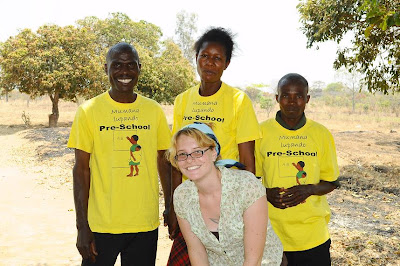

Ba Allan Mwango, Ba Catherine Chisha, Ba John Bwalya Kandeke, and I after their graduation.
- $921 has been donated towards the pre-school construction in just a few weeks. We still need $2872. Pleas e, please spread the word of this project. If you’ve already done so, please continue to do it. It’s pretty difficult raising publicity for what I’m doing when I’m in the village without access to any form of modern communication, so I need help. (Special thanks to Sue and Tim, Rick, Kate, and Sarah). Again the link is https://www.peacecorps.gov/index.cfm?shell=donate.contribute.projDetail&projdesc=611-061
Sunday, September 5, 2010
Videos
Project Explanation
Narrated by Nicole Barren and Allan Mwango
Shot at the location of the pre-school, the center of the village often called the station because it's where people hitch rides from. Hopefully it gives you a feel for the atmosphere. Unfortunately, it's very windy on September mornings.
Sukulu Yaliwama
Words: Po po umwana wandi
(Po po my child)
sukulu yaliwama
(school is good)
nokulemba nokubelenga
(and to read and write)
A song about the value of education may seem superfluous in the U.S., but in the village, parents are often uneducated themselves and thus the importance of school is not impressed upon children as firmly as it should be. The students' parents and caregivers, however, are supportive of the pre-school. In addition to educating their children, it also gives overworked women, some of whom are also burdened by chronic illness, a small break in caregiving duties.
Mango Tree
A lively call and repeat song that teaches English verbs. The kids LOVE it.
Donate to the pre-school construction at https://www.peacecorps.gov/index.cfm?shell=donate.contribute.projDetail&projdesc=611-061
Or www.peacecorps.gov, then click 'Volunteer Projects' and search by my name or country.
Saturday, September 4, 2010
Donate to the Pre-School
The Peace Corps finally put my project up on their website, so we can start accepting donations.
Please, please, please give the blog or that link to everyone you know. I've lived amongst, loved, and laughed with these kids for the past year and a half; they've taught me the Bemba language and accepted me as their friend. I came to Zambia with the intention of helping people, but the biggest change has happened inside of me. Ba Allan introduced us recently to a visiting relative as "These ones aren't Americans anymore. They're real Bembas." That inclusion into our adopted tribe has been repeated by other people too, and as a Peace Corps volunteer whose goal is assimilation, it gives me a great sense of accomplishment. But all the credit goes to the people we live with, who've taught me how to be strong and happy no matter how hard life may be, who've taught me Bemba songs, dances, cooking, and work. I've learned a lot from their children, too, my peers as far as language goes. In the beginning, they'd come to our house to stare because, well, not many white Americans jabbering in a foreign language make it to the village. Now they come to ask me to informally teach them, to play soccer and monkey-in-the-middle, or just because they're bored and want to talk. I wish I could take all of them to America with me when I leave. I like that village life is simpler, safe for children to wander by themselves, and close-knit. But I can escape it, I don't have to deal with most of the hardships. I want to save them from their futures; alcoholism, HIV/AIDS, early pregnancy and baby after baby, a 45-year life expectancy. But I can't. What I can do is build them a pre-school, which is sorely needed, to thank them for allowing us to enter their lives for two years. The most critical years of a child's development are ages 1-6. Pre-school gives them a good foundation and prepares them for grade one, gets them used to attending school regularly, fosters in them a love for learning. Pre-school education puts them at an advantage years later; children who attend pre-school are more likely to pursue adult education and adhere to development programmes. They have a head start at basic school, and a better chance at becoming literate. Short-term, they're going to be able to learn more effectively in a better-suited classroom and take even greater pride in it. This can make their lives a little bit better, put them a little bit closer to escaping the lives of their grandparents and parents.
I wish you all could come to the pre-school and see the looks of pride on these kids' faces when they write a number correctly, their smiles when they sing, and their eagerness when their hands shoot into the air to be called on. I hope the pictures can convince you to take an interest in these kids and help me help them. Even if you can only give $10, that's fine. $10 may not seem like a lot to you, but it's a very sizeable sum in the village; it can buy 100 heads of cabbage, piles of tomatoes, or bundles of greens, enough to combat malnutrition in an entire family for a very long time. It can almost buy a 50 kg bag of cement. Please help us out. And continue to check the blog; I'll update on the project's progress regularly.
The website is https://www.peacecorps.gov/index.cfm?shell=donate.contribute.projDetail&projdesc=611-061.
Alternatively, you can go to peacecorps.gov, click on 'Donate to Volunteer Projects' and search for Nicole Barren.
I also made flyers that I can e-mail by request (nicolebarrdette@gmail.com). For further information and pictures, look at earlier posts. Chris posted a whole facebook album of pictures of the pre-school at http://www.facebook.com/album.php?aid=211887&id=713467480&l=94dff03873.

Please, please, please give the blog or that link to everyone you know. I've lived amongst, loved, and laughed with these kids for the past year and a half; they've taught me the Bemba language and accepted me as their friend. I came to Zambia with the intention of helping people, but the biggest change has happened inside of me. Ba Allan introduced us recently to a visiting relative as "These ones aren't Americans anymore. They're real Bembas." That inclusion into our adopted tribe has been repeated by other people too, and as a Peace Corps volunteer whose goal is assimilation, it gives me a great sense of accomplishment. But all the credit goes to the people we live with, who've taught me how to be strong and happy no matter how hard life may be, who've taught me Bemba songs, dances, cooking, and work. I've learned a lot from their children, too, my peers as far as language goes. In the beginning, they'd come to our house to stare because, well, not many white Americans jabbering in a foreign language make it to the village. Now they come to ask me to informally teach them, to play soccer and monkey-in-the-middle, or just because they're bored and want to talk. I wish I could take all of them to America with me when I leave. I like that village life is simpler, safe for children to wander by themselves, and close-knit. But I can escape it, I don't have to deal with most of the hardships. I want to save them from their futures; alcoholism, HIV/AIDS, early pregnancy and baby after baby, a 45-year life expectancy. But I can't. What I can do is build them a pre-school, which is sorely needed, to thank them for allowing us to enter their lives for two years. The most critical years of a child's development are ages 1-6. Pre-school gives them a good foundation and prepares them for grade one, gets them used to attending school regularly, fosters in them a love for learning. Pre-school education puts them at an advantage years later; children who attend pre-school are more likely to pursue adult education and adhere to development programmes. They have a head start at basic school, and a better chance at becoming literate. Short-term, they're going to be able to learn more effectively in a better-suited classroom and take even greater pride in it. This can make their lives a little bit better, put them a little bit closer to escaping the lives of their grandparents and parents.
I wish you all could come to the pre-school and see the looks of pride on these kids' faces when they write a number correctly, their smiles when they sing, and their eagerness when their hands shoot into the air to be called on. I hope the pictures can convince you to take an interest in these kids and help me help them. Even if you can only give $10, that's fine. $10 may not seem like a lot to you, but it's a very sizeable sum in the village; it can buy 100 heads of cabbage, piles of tomatoes, or bundles of greens, enough to combat malnutrition in an entire family for a very long time. It can almost buy a 50 kg bag of cement. Please help us out. And continue to check the blog; I'll update on the project's progress regularly.
The website is https://www.peacecorps.gov/index.cfm?shell=donate.contribute.projDetail&projdesc=611-061.
Alternatively, you can go to peacecorps.gov, click on 'Donate to Volunteer Projects' and search for Nicole Barren.
I also made flyers that I can e-mail by request (nicolebarrdette@gmail.com). For further information and pictures, look at earlier posts. Chris posted a whole facebook album of pictures of the pre-school at http://www.facebook.com/album.php?aid=211887&id=713467480&l=94dff03873.


Subscribe to:
Posts (Atom)