Saturday, July 31, 2010

Kafue National Park

HIPPOS
The most exotic wildlife we've seen in our village is five-year-old Muso running down the path naked, so we were excited when we arrived at Kafue National Park and found hippo tracks the size of dinner plates on the bank of the river, only 25 ft from our campsite. However, what was novel in the daylight became frightening after sunset when the Kafue River became shrouded in darkness penetrated only by a glaring full moon. Hippos bellowed as we cooked dinner, the sound echoing over the dark water so that we could only nervously guess at their location. Around 23 hrs, we awoke to the sound of splashing and scraping along the bank, followed by lumbering footsteps and snorting. It was too nearby for comfort.

"Chris," I whispered as he peered through the mosquito screen, "What if it tramples our tent?"
He hesitated. "It won't."
"Hippos graze on land at night," I reminded him. "It's coming closer." Beyond our flimsy, nylon two-person tent lay a field of lush grass, kept green during the dry season by a sprinkler system.

We sat in the darkness, straining to track its movements by sound. Minutes passed slowly, but the hippo never strayed far. My heart leapt when it unexpectedly fell silent. I was sure it had heard us rustling and was creeping up, dangerously curious. But then it returned to foraging. We deliberated with growing dread. Should we wait for it to move away and then quietly slip out, and walk three minutes upstream to the lodge to wait out daybreak? Or where we safer remaining and being quiet? Chris dimmed his headlamp with his hands as I opened our Bradt guidebook. "Hippos are widely credited with killing more people than any other African mammal," I read softly. "Strongly territorial, herds of ten or more animals are presided over by a dominant male who will readily defend his patriarchy to the death." Close to hyperventilating now, we decided to wait for it to meander a safe distance away before we escaped to the lodge. We listened and waited as it slowly foraged its way downstream, our hope growing. Then it turned around. It was circling, not leaving. With resignation, we realized we were helpless, at the whim of an unpredictable 1,500 kg animal. After an hour, I began to calm down as I realized it hadn't strayed from the water's edge. My earlier adrenaline melted into exhaustion. "We can sleep in shifts," I offered drowsily to Chris. Two hours later it finally moved away.


BASIL

The following morning, we found out that was our first introduction to Basil, Mukambi Safari Lodge's resident hippo. A young male, he was violently chased away by another group but found a sort of refuge from harassment at Mukambi. He grazes on the grass in front of reception regularly and even enters the lodge. Once, a larger male hippo chased him right through the dining room in the midst of a meal, so the staff always watches him closely. When we were there, they hurried to block off the dining room and reception area with a wicker sofa when he came around. So Basil lay down and slept right there on the second floor of the stone patio overlooking the river like an overgrown house cat. For over two hours he was sprawled out as guests tip-toed behind the relative safety of the sofa and the glass-fronted doors of the lodge taking photographs.


LIONS

Kafue was the sixth National park I've been to in Southern Africa, the second in Zambia. I've been on many game drives and have seen it all. Except lions, which tend to be elusive. In Kafue, we were lucky enough to see two lionesses a total of three times. On a morning drive, we found a lioness in a dry riverbed, chasing away a pack of vultures. She pawed the sand where the carrion-eaters had been and plopped down to rest. Suddenly she rose, keeping her tawny square head at the same level of the long, sunburnt grasses, looking intently into the distance at a herd of puku. Lithely she stepped through the grasses, never losing concentration, not unlike a house cat stalking a mouse. 150 yards away, she stopped. The leader of the puku herd had spotted her and was staring at intently at her as she was at him as his unconcerned charges nibbled grass. Neither predator nor prey moved for several minutes, trapped in a staring contest. Our land cruiser moved on. More than likely, the lioness had lost her advantageous element of surprise and abandoned the hunt, preferring to pick up again in the cooler temperatures at dusk.

We saw her again at the same place in the late afternoon. She was on the opposite bank of the dry riverbed but crossed right in front of our land cruiser, undisturbed by the breathless humans eagerly snapping pictures of her.


Our second night camping, we heard a lion calling multiple times from the northwest. By the third time, it had undeniably gotten closer, but as their roars can carry a distance of over 8 km, he still could have been some distance from us. It was really amazing to sit around a campfire and hear lions and jackals though.

WARTHOGS


At the lodge's ground level, there's a storage area cut into the stone foundation containing bags of charcoal. And a resident family of three warthogs. To my extreme delight, they snort just like domestic pigs.


ET CETERA

In addition to watching vervet monkeys, puku, some amazing birds, and warthogs right in our campsite, we also went on two day game drives and one at night. Animals spotted: lions, bush baby, civet "cats", elephants, jackals, warthogs, vultures, puku, water bucks.

It was an amazing experience seeing this side of Africa that we don't get the chance to see in our daily lives.


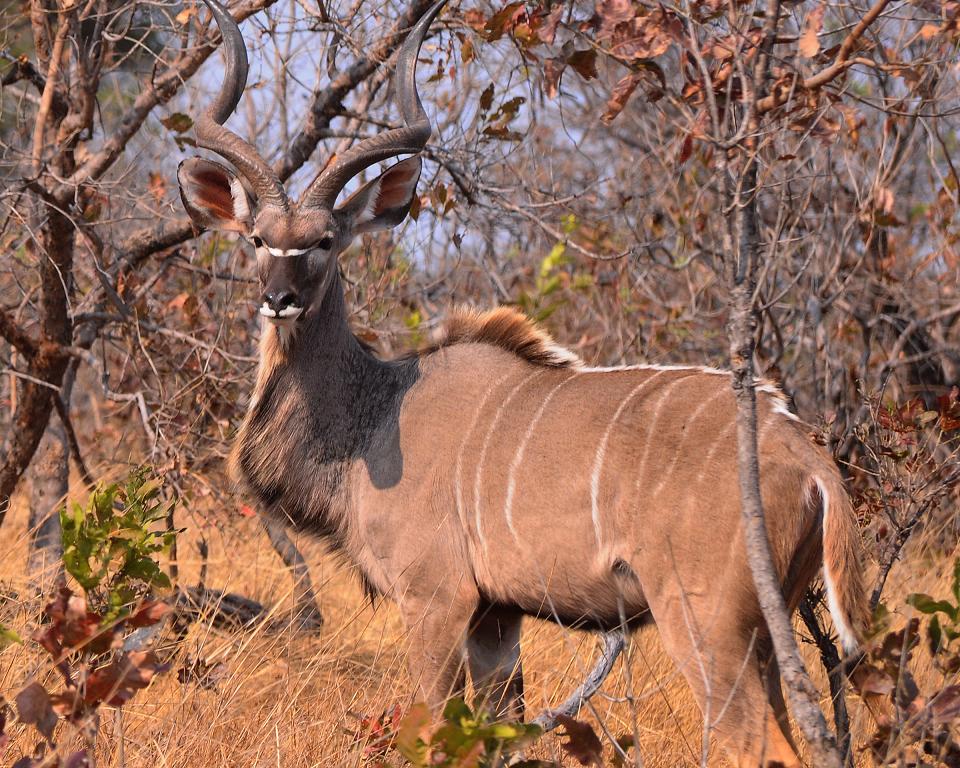
Top to bottom and left to right: A male kudu. Definitely the ugliest antelope.
Puku in flight and puku mother and fawn.
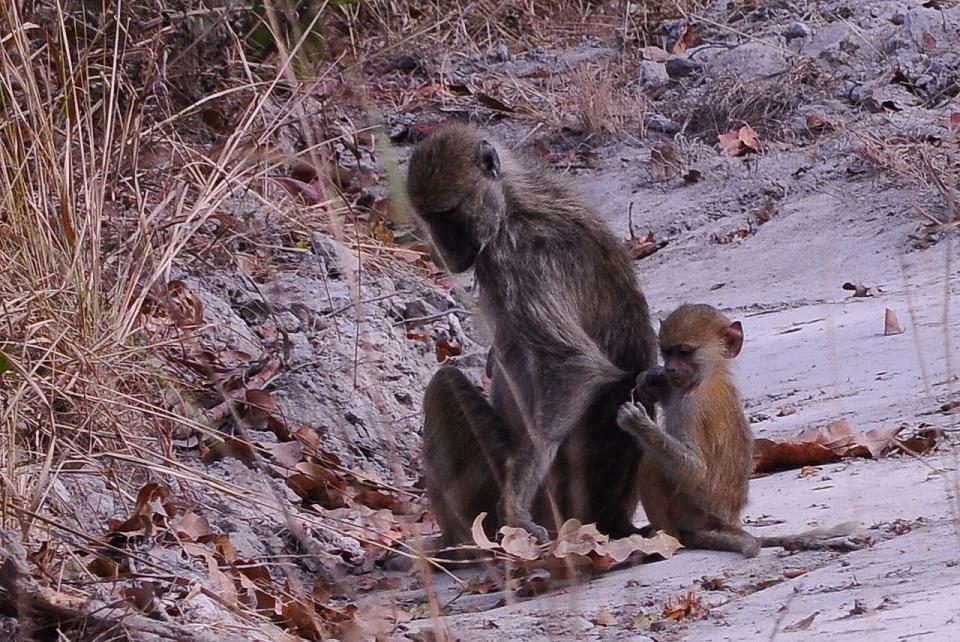
Baboons.
A bush baby. One of the few nocturnal primates.
Elephants sniffing the air to smell our scent.
A tree hyrax that fell out of its tree and landed with a thud.
A pretty bird that looks like a lilac-breasted roller, except its green.

Thursday, June 24, 2010

Funeral for a Child


I’ve become accustomed to the distended bellies caused by malnutrition, the fungal infections that cause the children to lose patches of their hair, and small dusty, bare feet running on chigger-infested soil. It’s become scenery just as much as the tall, thirsty grasses burnt by the relentless sun during dry season. But the death of a child is not something I can get used to. Despite the special cemetery just for children, with unmarked mounds strangled with weeds stretching far into the distance.
Mpundu Kandeke was five-years-old, with chubby cheeks and a bright smile like her father’s, a farmer Chris worked closely with. Sometime on Friday, she went with her twin brother and some other children into the woods to dig for bush rats, so their families could have some meat with dinner that night. She was young and a girl, so the boys told her to sit and wait for them. She didn’t see the spotted puff adder that blended in with the dead leaves and dried grass she sat on. It bit her on the thigh. On Saturday, her family managed to take her to the clinic, although their house is 3 miles from the road, and another 10 miles from there to the clinic, by the only transportation they had, a rusty Chinese-made bicycle. The clinic could do little for her. No clinic in Zambia could; there isn’t the infrastructure to store anti-venom.
She passed away on Sunday morning, nearly forty painful hours after she was bit. That same day, we and her father were supposed to play in a soccer match organized to celebrate the World Cup, which she probably would have watched. Instead, her male relatives were hammering her small coffin together.
In Bemba culture, twins are revered. You don’t wail for one twin if the other is still living. In this instance, though, her twin brother was the first to cry upon hearing of her death, making it acceptable for the rest of the family to mourn.
The morning of her funeral, the Pentecostal Church choir was singing in her grandmother’s yard for the mourners. Inside the small, empty traditional stick and mud hut, her mother, grandmother, and others sat around her body. It’s custom for mourners to sit for a few minutes with the body after they arrive. She was swaddled in a wool blanket, with only her face in view. The hut was dark and quiet and she was surrounded by her relatives on both sides. It was very peaceful, even after her mother began to softly wail, accentuating the melodious voices outside. She could have easily been only sleeping. Later though, as they prepared to move to the cemetery and drove the nails into her small, rough hewn coffin, that illusion was ruined. We were really going to leave this small girl in the ground, alone, away from all the houses in the village. She would become just another unmarked mound among many mounds, just another child lost. A too-familiar tragedy played out in the savage but beautiful landscape of Africa.

-------------------------------------------------------------------------
On 30 June, two proposals I’ve spent the last three months working on will be evaluated. The first is for almost $200 funding from USAID to train three volunteer pre-school teachers in curriculum, lesson planning, and learning aids. The Kasama Pre-school Teacher Training College has agreed to facilitate this five-day workshop for free, although such a training usually costs around $400. The money requested is just to cover stationary supplies, transport, and food.
The second proposal is through the Peace Corps Partnership Program to construct a pre-school building. Since 2007, the pre-school has been using a cramped, abandoned general store as a classroom. The problems with this arrangement are many. The shack is located in the center of the village, where the men drink home-brewed beer, there’s always a radio powered by a car battery blaring, and older children duck in and out to satisfy their own curiosity. Adding to the distractions, there are no chairs or desks, and children crouch together on pieces of broken brick. The floor is dirt, and in the absence of a blackboard, functions as a slate upon which to practice writing letters and numbers. There’s no locking door, so the learning aids utilized by the teachers are restricted to what they can carry in and out each day. Finally, the students are orphaned or from families dealing with HIV or other chronic illnesses, so they especially are prone to fall through the cracks. The pre-school functions to instill in them an early love for learning and prepare them for basic school, but it’s difficult to impress upon them the importance of education and their own self-worth when they’re learning in a dilapidated, ill-suited classroom.
The money for this PCPP comes from you, my family and friends in the great United States of America. The community has agreed to donate local building materials, labor, and equipment, but they cannot contribute the necessary $4,000 in cash. As subsistence farmers, each family survives on a mere $40 a year.
If Peace Corps approves this proposal, I can begin accepting donations in 1 – 2 months. There will be a Peace Corps-affiliated website where you can donate. Of course I’ll post further information, as well as pictures. Please, please pass it on to any individual or organization that you think can help. The kids love attending their pre-school and it really has great potential to prepare children for basic school, improve literacy rates, and keep more children in school for longer.
Stay tuned…

Wednesday, June 2, 2010

Rotten Guavas

So, recently, here at TBPLTB, we've been doing some thinking. Have we gotten ourselves into a rut? Is it time to move away from the same old text and pretty picture posts we've been doing for the better part of our services? These questions were met with a resounding YES.

Please enjoy our lives through the quirkily honest lens that is Rotten Guavas...


Wednesday, May 12, 2010

Livingstone and Victoria Falls


A mature baobab, hosting buffalo weaver
birds, and a nesting stork


In the beginning of May, we had to come to Lusaka for our Midterm Conference and medical physical and tests. We both got a clean bill of health, including no tuberculosis. We were a bit worried because everyone in the village seems to have a persistant cough and chickens wander in and out of huts regularly. A lot of the young girls have deep, hacking coughs similar to those produced by an 80-year-old lifelong smoker. Of course, they also spend a lot of time sitting in smoke-filled insakas, leaning over cooking fires, so that could be a contributing factor as well.
This also marks the halfway point of our service. 13 months down, 12 months to go. At this point, Peace Corps Zambia tells us, it's common to have a nosedive in morale. You start feeling like the difference you're making in the village is marginal, like your family and friends in the U.S. have forgotten about you and moved on with their lives, like you've changed too much to fit back into your old life in the states. Chris and I both feel this, along with most of our intake. (speaking of which, our original group has diminished by 9 people since February 2009. Most people were medically separated, others chose to go home). So we had a touching rededication ceremony, received some helpful project-specific books, shared ideas about what has and hasn't worked for us at our individual sites.

For some reason, Peace Corps thinks married couples should stay in a quiet guesthouse 2 kilometers away from all the other volunteers when down in Lusaka on official business. So Chris and I, and Daphne and Tyson (a LIFE couple from Kansas living in Central Province) were corralled into Cheshire Homes Guesthouse while our twenty-odd other friends stayed elsewhere. This turned out to be not so bad because Cheshire Homes is actually very nice, and we met an older American staying there named Craig, a returned PCV from Samoa in the '70s. He's a professor of epidemiology at the University of Alabama at Birmingham, and is director of some global health programmes, and travels to Zambia frequently for work. He bought the four of us dinner at a nice Indian restaraunt, and a book about Zambia that he found out we'd never read. It was really nice that we had this instant connection to someone we might not normally know, just through similar experiences.
One night, we went out bar-hopping with our intake. We hired a mini bus to take us around for the night. We started at the new casino at Arcades Shopping Mall. Lusaka surprisingly has two classy casinos now. The first bar we went to, the band that was supposed to be practicing didn't show. So Chris picked up an electric guitar on the stage and started jamming with two Zambians that were milling around. They were really into it, and invited him to come back a few nights later. Unfortunately, we couldn't. We moved onto another bar, then ended at the infamous Alpha Bar. Infamous because if you aren't careful, your phone or money will be stolen, and it's where the prostitutes loiter; women squeezed into too-short skirts and plunging necklines hanging onto men in business suits. However, it also happens to have the best atmosphere. Inside, they blare Zambian pop music over a strobed dance floor, and outside, there's a quieter porch with picnic tables. I don't think anyone ended up getting more than 4 hours of sleep that night, before we had to be up at 8am for a session.

After MTC, Chris and I decided to take a four-day vacation in Livingstone. Livingstone, home of Victoria Falls, one of the seven wonders of the world, is the most touristy part of Zambia. It's 6 hours south of Lusaka, and the Falls are flanked by Zimbabwe across the Zambezi River. It's also very close to Mosi-o-Tunya National Park.
Victoria Falls themselves make Niagra Falls look like a small brook trickling over a pebble. It's the end of the rainy season now, so we saw them in their full grandeur. They're about 2 kilometers in width, and plunge into a deep, carved gorge sprinkled with rainforest foliage. It's really breathtaking. You can walk all along them, and onto a bridge cutting across. The spray is so strong that your clothes unavoidably become soaked through, even at a distance of 1 kilometer away. They even have a rent-a-raincoat stand set up at the entrance to the Falls. At the bridge linking Zambia to Zimbabwe, you can bungee jump off the side into the gorge. There's also light aircraft and helicopters that will give you an aerial view of the Falls. Unfortunately, it's a little beyond our volunteer budget.

The Boiling Pot and the bridge where people bungee jump


If you really squint, you can see someone at the end of her/his jump.

The person on the left is coming to "rescue" the jumper before all of the blood rushes to her/his brain.

Our first hike, before we got soaked, was to the Boiling Pot, the massive, turbulent pool under the Falls. It was a beautiful walk through vivid rainforest foliage, with birds calling over our heads and monitor lizards sunning themselves on rocks.

A view from the "Boiling Pot" trail.


On the way back up, we encountered a troop of baboons foraging on the steep hill. There were about twenty in all, from small babies clinging to their mothers to a few large males strutting around. At first I was a bit nervous, because baboons are about German Shepherd-sized and have very sharp canines, but they seemed rather habituated to people wandering around, and ignored us. Until Chris dropped his open bag by our feet (we were with an American living in Tanzania named JJ), and walked up to take a picture of a baboon that was sitting on a garbage can, banging it like a drum. I was transfixed by a very adorable baby clinging to its mothers' back as a male groomed her. Another female walked over and the male grabbed the baby, walked a few meters away, and sat down to play with it. This wasn't necessarily the father; baboons have an interesting social network in which they make friendships that are sometimes lifelong, but don't always mate with that individual. I didn't even notice the male that had ambled up to us until he grabbed Chris' bag, spilling his new internet phone and other belongings on the hillside. I watched in horror for some long seconds as he picked through the bag, dragging it downhill, and considered whether I should throw a rock at him. Then JJ growled at him and raised his arms, and the baboon skulked away, realizing a bag without food wasn't worth the trouble. This occasion marked the second time in less than 4 months that a primate has rifled through our bags and stole things. (The first was when a vervet monkey named Jocko opened my bag and stole some hairclips. Luckily, like a dog, he was easily fooled when I picked up a leaf and pretended it was extremely interesting, quickly discarding the clips in favor of the new thing).

This is a good baboon. She didn't steal anything from us.


Here we are after a good soaking from walking around the falls.


JJ. Our hero.


We went to Gwembe Crocodile Farm the second day to catch a feeding. They have about 20 adult crocodiles that were wild-caught from the Zambezi River, mostly because they were causing trouble. For example, there was one female that was stealing campers' backpacks. Once she even took off someone's foot that got to close to the water, at which point she was relocated. Now all of the crocodiles are used for breeding. Their eggs are incubated at another farm, and the young are used for meat or crocodile skin products. We tried some crocodile meat, and it's pretty good. It tastes like a cross between fish and chicken.

A 1 1/2 year old crocodile we like to call "Dinner"


Our guide actually nonchalantly jumped down into this croc's enclosure and hit him on the snout with a stick to show us his teeth.

*No animals or people were harmed in the making of this picture.

One thing that surprised me was how massive adult male crocodiles can get. They're easily the size of a four seat couch, as long from head to tail as a full size pickup truck. They're not horribly exciting to watch, you can easily mistake one sunning itself on the bank for a statue. They're fed chunks of raw cow meat weekly. They become animated when the meat is dropped into their enclosure, huge jaws with pocket-knife teeth knashing in the air, stubby prehistoric bodies sliding over the ground.


We also went on a sunset booze cruise on the Zambezi River. We heard it was likely we'd see hippos or crocs as we were sailing through National Park waters, but the water level was too high. We did get a nice view of the sunset though, and as much alcohol as we could drink. We ended up spending a lot of time with a Bemba man named Kelly. The predominant tribe in Southern Province is Tonga, and many people speak Nyanja (which is very similar to Bemba. We can understand some of it, but aren't able to speak it). Kelly, though, was originally from Northern Province, very drunk, and excited to be speaking Bemba, a language not commonly used in Livingstone. He was a tour operator and kept pointing out all the other boats on the river to me. Apparently, the large double-decker boats were all Zambian, while the smaller ones came from the Zimbabwean side. Of course, Zambians are proudly nationalistic (There are private companies named ZamBike, ZamBeef, ZamChick, ZamTel, and many more), so this could have been complete heresay.

Obviously not a Zimbabwean boat.


The following day, we went on a "lion encounter." There's an organization named ALERT in Zambia and Zimbabwe that works specifially on lion conservation. They relocate at-risk lion populations and orphaned cubs. Starting at 6 weeks old, cubs are taken on walks in the bush in order to become familiar with it and develop hunting instincts. Once they are able to become self-sufficient, they are put in a fenced, managed area with no competition like hyenas, and allowed to form prides on their own. Finally, they are released into the larger park to have wildborne cubs and become completely independent from humans. So Chris and I went on one of these walks with three 11-month old cubs named Rwanda, Rema, and Rafiji. There were guides with us, and two scouts walking ahead to make sure we wouldn't run into any game. The cubs were playful with eachother, rolling and tackling until they turned into one large blur of golden fur. Chris took some great pictures. At one point, the male Rwanda found a pile of elephant dung and began rolling around in it. Whenever lions find dung they will cover themselves in it to disguise their own scent, so that their prey becomes confused.


Elephant dung: catnip for lions.

Our final activity was a walking safari in Mosi-o-Tunya National Park (only 66 km2). I've only been on game drives before and was afraid that being on foot, we wouldn't cover as much distance, and would be less likely to see any animals, but the opposite was true. On foot, we were able to get deeper into the bush past the roads, and weren't competing with other Land Rovers. We went on the walk with a German couple, the company owner, and a game scout, walking at the front with an AK 47. The AK, he told us, was to fire into the air to scare away an animals in case of an incident. That, and for killing poachers. The first animals we happened across were a herd of zebra grazing on the savanna. We were able to slowly get closer, until we were about 40 feet away. The stallion made sure to stay between us and his herd, keeping one eye on us while he lipped sunburnt grass. The rest of the herd meandered away to keep some distance, then indifferently returned to grazing, flicking their ears against flies. A small brown oxpecker with a red beak perched on one of the zebra's withers, eating its parasites. Slowly, the herd moved

away, and the scout pointed into a thicket of small trees, where a buffalo was staring at us. Unfortunately, we were in an open savanna while the buffalo had the advantage of cover, so it was unsafe for us to approach him any closer. Undoubtedly he had friends hidden from us nearby, so we didn't want to stumble into a herd of buffalo, and gave him a wide berth. We edged away, but he continued to watch us uneasily. Then, a solitary giraffe with eyes half-closed crossed our path, not noticing us until he was just 25 feet away.

He looked at us curiously once from under a fringe of thick eyelashes, then turned to a scraggly low tree. He too ambled away, and we continued, all the while with the buffalo still glaring at us. The scout went ahead because he spotted a rhino in the trees ahead and wanted to make sure it was safe for us to approach. For the grand finale, we were 25 feet away from a white rhino, dozing in the shade. White or square-lipped rhinos are among the rarest of Africa's endangered species. There are only five in the whole 66 km squared Mosi-o-Tunya park. Female rhinos have a gestation period of 18 months, then raise their young for five years. This means female rhinos only have two young during their lifetimes; three if they are extremely lucky. The large male dozing in front of us was one of a dying species. Unconcerned with us, he laboriously shifted onto his side, then stood up, all 3 tons of him. He had intense marble-sized eyes under long, horse-like ears and a snout with two horns underlined by his large, square lips. Except for a hump on his back, his wrinkled body almost looked like an elephant's.

After admiring him for fifteen minutes, we trekked back to the Land Rover, and took the long way out of the park, and managed to see some baboons and vervet monkeys, a family of running warthogs, countless impala, and some hornbills, beautiful graceful cranes and a vulture, both carrion eaters. This was Chris' first game park adventure (and almost, I feel, a rite of passage for travelers in Africa), and he was ecstatic, looking at me every so often with a big grin. I've been on several game drives in South Africa, including a night one at Kruger National Park, but never have I had an experience like this one. A walking safari is definately the way to go to get up close to these animals.

Wednesday, April 21, 2010

We're Getting a Well!

After one year of worrying about a lack of clean water in our village, and having insufficient funds as Peace Corps Volunteers to do anything about it, Appropriate Projects has solved our problem in a matter of days:

Link to Mumana Lupando Well Project:
http://appropriateprojects.com/node/169

Appropriate Projects has approved our proposal and within a month, approximately 250 people in our village (including us) will have clean water.

A great charity to donate to. Twatotela sana (Thank you very much), Appropriate Projects!

Saturday, April 17, 2010

Umweni wakolwe...


Every month, our counterparts' group in conjunction with Safe Motherhood weighs all the children in the village under age 5. Zambian children don't regularly visit doctors for check-ups like American kids, so this is a way to monitor a child's growth and take early action if they are not growing as they should. Most every child in the village is mildly malnourished due to a lack of fresh vegetables and protein, but growth monitoring looks for severe malnutrition that could be life-threatening. Ba Allan tells us that during the hungry season, most childrens' weights dip.

The women in green is one of the twins' wife (dedicated young men in my English class). The woman in yellow is Ba Maureeni, my counterpart's (Ba Catherine's) younger sister.


Beauty pretending to be shy at the baby weighing. Don't let her fool you, she's the most charismatic five-year-old I know. Her mother, BanaPeggy, is the woman featured in the very last picture.


My first soya bean cooking demonstration. Chris and I pedaled soya beans a few months back, because we wanted farmers to grow them. They are very nutritious and contain more protein than other legumes.
As promised, I had a cooking demo to teach how to prepare them. Joan (our former PCV neighbor in the blue apron, who sadly finishes her service in a matter of days) was on hand to help, as was Ba Chongo the community development officer and his wife.
We prepared fritters made with soya flour, soya bean sausages, soya milk, and soya coffee. It was all surprisingly very tasty. Once Chris' harvest is ready, I want us to make our own soya milk. Joan serving up soya flour fritters.

Yangu! A Zambian man cooking?! BashiMpalo (father of the frequently mentioned rambunctious Mpalo) making fritters. When I specifically asked for a man to volunteer to help, most of the men snickered, but BashiMpalo wins brownie points for volunteering.


A view of the whole soya demo, with our house in the background.


Our visitors, Peace Corps trainees who will hopefully swear in as volunteers in a week. They visited us for four days to learn what it's really like to be a volunteer. Chris insisted on putting them to work in Ba Allan's garden. They are (from left to right) Amanda (AKA Musonda), Brian (AKA Chishimba) and Courtney (AKA Chileshe). The Zambians are their Bemba language trainer Ba Golden, and Ba Allan (who, according to Joan, has a "smile like sunshine"). Joan and I sat in the shade and roasted maize. One of the highlights of their visit is definately the feast Ba Allan fed us all; corn/millet nshima with chicken, chikanda ifisashi (African bologna in a creamy peanut sauce), cabbage, and beans.
On the trainees' first night, we organized a dance party under the full moon. The plan was for some of the village girls to sing, drum, and dance. We invited just our counterparts and neighbors whom we're friendly with, and planned to have it at our house. An hour before, our neighbor Mutale came with the message that we should move the party to the football pitch by our house, because more people would come than we expected. When we arrived, we found half of the village there waiting for us. There were probably over 150 party-crashers! I was amused that so many people would show up when we didn't invite them, but when I try to organize community educational events and send out many reminders, only a couple dozen people show up at best.
The dancing was a lot of fun; everyone really enjoyed when the trainees tied citenges around their hips and entered the dancing circle. Chris has Zambian dancing perfected and always hams it up, getting the bamaayos hooting. The next night, the girls pleaded for us to do it again, so we played a mixture of American dance music and Zampop on our iPod. The following night, they pleaded again. I said we were too tired and wanted to relax. We later found out we'd been spotted at Ba Allan's house on the second day, so people came to his house at night to wait for us because they thought we were coming to dance with the other half of the village.


Ba Astone and his family. Ba Astone is in my English class and works on farming with Chris. We teased his daughter Mary (covering her face) that we were going to take her to live with us. Ba Astone invited us to his house to see his permaculture garden (a method of farming Chris taught):


He didn't use chemical fertilizer, only intercropping with soya beans and double digging (to reach the more fertile underlayer of soil).


BanaPeggy and her permaculture garden. Unfortunately taken after she had harvested much of her corn and veg, so it's not in its lush, abundant glory. She's planted a living fence to keep out chickens, goats, pigs, and our dog.


We celebrated Chris' birthday on 13 April with a picnic in the jungle. There's a small waterfall and a shallow stream 1/2 a kilometer behind our house where we ate roasted maize and homemade tortillas with tuna fish. The dogs followed us and carefully avoided all water, being sure to bark agressively at every bird that sang in the canopy. I was a bit disappointed each time, because I thought they were barking at vervet monkeys. I sewed Chris a citenge patchwork guitar strap. We wanted to make a cake, but unfortunately we didn't ration our Blueband (butter we use at site that doesn't need refrigeration) well enough, so we had to wait until last night to make Chris a chocolate cake with chocolate frosting.
Sable has gotten serious about paving Luwingu Road (or rather, Luwingu Creek in the rainy season), and has started driving a bunch of construction machinery on our stretch of the road. They've actually compacted and redistributed the sand so that the road is straight, rather than riddled with potholes and a one meter deep gully on one side. Road construction has turned into a spectator sport. If you are trying to find someone and they are not at their house, more than likely they are sitting by the side of the road watching the development. The day Sable started, the village declared it an unofficial holiday. Girls were running around with their hair brushed and their Sunday dresses on, and the adults took the opportunity to brew and/or drink beer.
Most of the Sable workers are OK. One even offered to let Chris drive his compactor. The bwana is very nice and is letting me do an HIV/AIDS program with the men next week. A lot of the workers have gotten free condoms from us, and as a transient population with disposable income, they're at high risk for HIV, so I'm excited about doing this program with them. He's even agreed to pick us and drop us in the company Land Cruiser. There's one bulldozer operator named Bright who's always drunk that's decided Chris is his best friend. He's bragged that he's reached grade 9 and is the son of a chief. My favorite thing, though, was when he mentioned "the two tribes in South Africa; the blacks and the whites." I laughed openly at him.
Our neighbor, Mutale, is unable to continue to grade 8 because his parents can't pay his school fees. He's 18 years old (this doesn't mean he's failed, rather kids in the village start school late. It's not uncommon to find a 20-year-old in grade 5). This past year we have always spoken Bemba with him, peppered with the occasional English word if we don't know its Bemba equivalent. I always thought he only knew a few words in English. I was quite surprised when Brian, one of the trainees, who hasn't had time to learn much Bemba yet, had a long conversation with him in English, and that the conversation was mutually understood. Come to find out, he can understand Bemba decently well, but is less proficient at speaking it, which is why he prefers to use Bemba. This revelation came around the same time he asked me to teach him English because he can't continue to attend school, so I have been working with him. My mother sent some childrens' books that have been very helpful in practicing English. He reads in English and I have him translate it into spoken Bemba so I can be sure he understands. I gave him the homework to translate one of the books into Bemba without my help, and I think I'm going to write the Bemba below the English so that I can read it to the kids. We also understand better than we can speak, so the kids mostly get frustrated with my broken translations and flip ahead to the next page.
Mutale and I were talking about bushmeat one day, and he flipped through our African wildlife guide and showed me what exactly people eat. Usually, when they sell chunks, they only call it "bush meat," when it could be anything from antelope to wild cat. What is eaten: naked mole rats, bush rats, monkeys, wild cat, antelope, (and less commonly because there are poaching laws and you can only find them in the National Parks now days:) elephants, hippos, and water buffalo. What they won't eat: house rats (they are too closely associated with humans and disease-ridden), apes (too closely related to humans), zebra, wild dogs or wolves (because they are too much like dogs).
Best Zambian Names
All are actual, legal names of people we know
-- Wonder
-- Ten Ten
-- Passwell (a taxi driver)
-- Innocent
-- Loki
-- Obvious
-- Gift
--Bright
Traditional Beliefs
One day, our language lesson transformed into a culture lesson.
A lot of Bemba tradition was lost due to colonialism. The British encouraged the Bemba to assimilate more than other tribes to become Zambia's working class.
ICINKULA
A useless, bad luck child. If a baby's first teeth come in on the top rather than the bottom, they will bring bad luck to the family. You can't take these babies to the fields or they will bring bad luck, killing the crops, and causing hunger to the village. Prior to the 1950s, babies whose teeth came in on the top were killed.

TRAVELLING
If you're traveling and something bad happens by your home, you will be troubled with nightmares or bad luck. If you start your journey on an empty stomach, it's a bad omen for the remainder of your journey. You won't eat. If, however, you are travelling and pass a que of black ants across your path, you will eat well at your destination.
THE MOON
When the crescent moon is tilted vertically, it is pouring diseases down. Usually this happens in April or May.
MALARIA
Malaria is a catch-all name for any illness. Very rarely will people actually have malaria when they say they do. Usually it can be anything from a headache to abdominal pains. Panado (like aspirin) cures everything. The cure for toothaches in the village is to swish your mouth with petrol gasoline to numb the pain.
If you eat too many mangoes, you will get malaria.
ICISUNGU
Day-long initiation ceremony for girls. She is taught how to behave herself as a lady and how to take care of her body. At the end, sticks are thrown on the roof of her house to signal that she's now a woman.
FIRSTBORN CHILDREN
Pregnancies are hidden. You should never ask a woman if she is pregnant. There is a possibility that the woman will be bewitched and lose the baby if a witch with a vendetta finds out. For this reason, pregnant women should not urinate in the bush or a public place. If a pregnant woman dreams about a relative that has passed away, it's that relatives way of saying that they want the baby named after them.
It is preferred that firstborns are born at home rather than clinics. For one week after the baby is born, until the umbilical cord falls off, the father or others can't see the baby. It is kept inside the house. After it falls, the fathers' sisters bring a gift of miller and name the child after an honored dead relative. If the baby cries through the night after its born, it rejects the name.
DEATHS OF BABIES
Miscarriages or stillborns happen because the spirits have not meant for you to have the baby. If infants die, it's the parents' faults for engaging in a taboo. Maybe the father has been having an affair, or the parents are sexually active (they should abstain until the mother has finished breastfeeding). If the mother becomes pregnant while she is breastfeeding one baby, she must stop because her milk is contaminated.


-------------------------------------------------------------------------------------------
John- We weren't able to find Mercury and Venus in the sky. There are a lot of trees blocking our view of the horizon in the west, so maybe that was part of the problem? The big dipper is tilted in the north right over our house and we think Orion is in the west, but that's about all we can identify. There's also no lights for 80 kilometers, so you can see so many stars, which complicates matters too. We just received (in mid April) your fourth letter with the viewing glass for the eclipse. It was postmarked mid December from the U.S.

Tuesday, March 16, 2010

Ba nzolola

There have been some unfortunate events both in our village and to Peace Corps staff in Kasama, so I am going to get to the bad stuff immediately, so I can expel it, then forget it and move onto happier things.

The worst news: We had just got into Kasama after a 3 1/2 hour ride on a bumpy, empty Sable fuel truck when we happened to meet our PCVL, Ted, in the Shoprite parking lot. It turns out that our Northern Province driver, Ba Lameck, narrowly avoided being beaten to death and is in jail, awaiting a court date. Before I say anything else about the incident, a note on Ba Lameck's character; he is very professional, caring, and supportive. All the volunteers like him, and he's been on Peace Corps staff for years.

Ba Lameck was driving the Peace Corps land cruiser east on Luwingu Road (our road) about 25 kilometers outside Kasama. Ba Jonathon (the provincial coordinator), a volunteer that is our closest neighbor, and the Health project director were with him. A vehicle passing in the other direction went by two children on bicycles. The children thought the road was clear and were riding in the left lane, as the shoulder was too sandy. Ba Lameck beeped and one of the kids jerked his bike to the side, but the other kid, a boy, froze, struck by fear at the approaching cruiser. Ba Lameck hit the brakes, but it was a situation in which only a split-second reflex could have saved the boy. The cruiser killed him instantly, his bike becoming tangled between the vehicle's front tires. Immediately, women from the village started to wail loudly, and a crowd surrounded the cruiser, making big scratches in it. A group of men began to beat Ba Lameck ceaselessly, not stopping even when he was lying still and bloody on the tarmac. Ba Jonathon tried to help, but they began to beat him as well. The health project director pleaded with the men to stop before they killed Ba Lameck. The man who threw the first punch finally took pity and carried Ba Lameck into his house, sparing his life.

The police were called and Ba Lameck was arrested. Peace Corps paid all funeral expenses for the family and a very generous sum of compensation, equivalent to about ten years of farming high yields of cash crops. Driving recklessly, the charge, is only a civil offense, so after a steep fine, Ba Lameck will most likely be released. I'm sure, however, that the accident will haunt him for the rest of his life.

The rest of my bad news is mild compared to this tragedy. I've written before about our lack of a clean water source. Our well is open, not covered, fed by a spring, and at a lower elevation than the rest of the village. Sometime around November, a baby straddled to a woman's back peed while she was drawing water, contaminating the water. It was cleaned, and I held a meeting to elect a well committee and stress the importance of clean water to health.

Since people have returned from imitanda, in the last month, they have disregarded all previous rules. Kids were throwing mango pits, musuku seeds, chewed up cassava into the well or carelessly discarding it nearby, so that it washed into the pit. Most people were not washing their jerry cans before they drew water. These jerry cans most likely came in contact with animal or human feces at some point. Every house has a flock of chickens, sometimes goats and a dog, that inevitably poop in their yard or insaka. Most people also don't have a latrine, and children especially pee wherever. Parasites are prolific, and it's probably safe to assume that jerry cans that are set in the sand are becoming contaminated. Also, jerry cans can also get dusty or gritty. Women were also washing their dishes and clothes in the furrow upstream. There are banks to divert water, but these become erroded from people walking on them, and one heavy rain (and it rains every day) could wash the soap or nshima residue into the well. The last straw though, came when a child pooped about 15 feet upstream of the well. It was on a rock, right on the path. Hello hepatitis, cholera, dysentery, diarrhea, giarrdia, intestinal worms, e. coli...

Chris and I were livid. That is our only source of drinking water. The next closest well is about a mile away. Too far to draw water from twice a day and carry back to our house. A 20-liter jerry can is very heavy, about forty lbs. and we don't have a wheel barrow or a pack mule or anything. And we go through about 20 liters of water a day, much more if we have to wash clothes or bathe.

So we immediately started a door-to-door campaign of the village on the importance of clean water for life. Most families don't treat their water, and diarrhea can kill people with already low immune systems, especially small children. There's also a fair amount of people that are HIV+ or have other chronic illnesses like TB. We tried to get across the point that not following the rules of the well could be killing your neighbor. In two days, three groups visited over 60 households, and spoke to over 150 men, women, and children about clean water. And people began to listen. Chris went to draw water with the 20-liter jerry can and gave two 2.5 liter jerry cans to Muso and Mpollo (both about 5 years old) to carry so they could help. Mpollo told Chris that his dad said little kids aren't allowed to go to the well anymore (without supervision, one of our rules). Chris told him it was OK, because he was there to teach them. When they arrived at the well, Mpollo suggested on his own that Chris do the actual drawing of the water.
(By the way, Mpollo is the boy in the black shirt in the top most photo on the left sidebar, and in a pink Dollywood shirt in the bottom one. Muso is in a jean dress in the top photo)

Our teenage neighbor came to our house to tell us there was poop (amafi in Bemba) in the well we use to clean jerry cans. We went down there and it turned out to just be a rotten guava on closer inspection, but one of the women immediately drained that well and shoveled out the sludge to clean it anyways. People seemed to be following the rules. Then, nature turned against us. Three days ago, our last full day in the village before we came here, our neighbor came to us distraught with an empty jerry can. Torrential rains earlier that day, coupled with the fact that the Sable workers fixing the road had diverted the water to go down a path that led to our well, had turned the path into a rushing stream, breaking the barrier, and ending up in the well. All the chicken turds, garbage, fruit pits, etc. that were within 1 kilometer uphill were washed down straight into our drinking supply.

Chris and I boil cooking water and both boil and filter water we just use for drinking. I think these methods kill pretty much everything, even if there is human waste literally in the water, but we plan to call the Peace Corps medical officer tommorrow just to make sure. Please, don't take your clean water that flows from taps right into your house for granted.

As I mentioned, the Sable road workers have come to our village. The plan is to pave the entire 160 km stretch from Luwingu to Kasama by next year. So far, only about 25 kilometers just outside the two cities are paved. They set up camp about 4 kilometers outside our village, and proceeded to bulldoze 25 feet on each side of the road. Our village used to be sort of pretty, but countless trees were taken down, and it sort of looks like a post-apocalyptic wasteland now. Straight out of Cormac McCarthy. There's now a 70 foot long stretch of sand littered with crumpled tree corpses that bisects the village. Apparently closing off one lane at a time to fix the road is not an option; they need one side to park their equipment and the other to build a new diversion for traffic. Or some nonsense. Trees are dispensible; deforestation is irrelevant; a tarmac road will bring development!

Enough with the ranting. There's been some good, too. Our host mother gave birth to a girl, her seventh child. She had some pain in her abdomen after the birth and was taken to the clinic, but they're both fine now. When we asked our host father whether it was a boy or girl, he mumbled "a netball player." They had 5 girls already, so I think he might have been hoping for another son.

Ba Allan's son, little Chris, is getting very fat and likes shouting incomprehensible baby words. His wife and sons went to farm beans near Luwingu for the past couple of months, so it's been a while since we've seen them.

On nights with full moons, people like to sing and dance and drum, so one night after eating nshima, we followed the music to our neighbor's house. The girls really liked that we were dancing with them, and begged us to come with Chris' guitar the next night. They've been teaching us Bemba songs.

My favorite: Ba (insert some name here) batuwina, mulelya kalembula. Oh, cashinka fye, cashinka fye (at this point in the song everyone bends into the middle and claps their hands).

Then there's some others I haven't yet memorized but we have written down. There's one with a pretty tune that starts off Indeke yapita apa, yapita speedi nomwela... The airplane is passing there, it's passing with speed through the air, then the next line is about the plane writing "(football) players" in the sky, and below that "prostitutes." Apparently, it's used to taunt the other team during a game. There's another song they taught us about prostitutes too, it seems to be a common theme?

In exchange, I've been teaching the girls the song Head, Shoulders, Knees, and Toes. It's really fun to hear them sing in English.

Other than the door-to-door clean water campaign, I've been working with Ba Allan and Ba Catherine on writing a proposal and a budget to get a grant for a training for early education teachers, and to build them an actual pre-school structure. Right now, they teach around 50 kids (all orphans or children affected or infected with HIV)crammed into a deserted tuck shop. The kids sit on broken bricks and write their letters and numbers in the dirt with their fingers.

And now, I present you with some of our favorite quotes:


--- "He is my cousin. He is from Mparapata. He is mad." - our friend, to Chris

--- Nakonde amaguy: "Where is your sister?" (meaning Chris)

Me: "He is coming."

--- "There is one; she is too fat." -Zanzibari hotel desk clerk, describing a woman in a group. We were trying to find our friends.

---Chris: "How many hoes do you have?"

Ba Allan: "Me, I have two. But in fact, every member of the family should have one. They should have their own and not use anyone else's."

Chris: "Like toothbrushes?"

--- A story our host father related to us about a conversation he had with Mpollo:

Mpollo: "Why don't you drive your car?"

BashiAmos: "It's broken."

Mpollo: "Why don't you fix it?"

BashiAmos: "I don't have the money."

Mpollo: "I will give you money. I just planted two gallons of beans in my garden. I will have a lot of money."